97% of the 'Keywords' Naive ATS Checkers Test for Are Company and Product Names, Not Skills
ResumeScorePro Research · October 2026. We ran 1,000 sample resumes through the exact checker that runs on this site, against 1,000 real job postings, and counted every flag it raised. The most interesting result was about the measuring stick itself.
The one-line version: 97% of the 'keywords' naive ATS checkers test for are company and product names, not skills — and even on skills alone, 4 in 10 resumes match less than half. Separately, 82% of the resumes didn't contain enough measurable results. Proof of impact is where resumes really bleed points; formatting, the thing people obsess over, mostly isn't.
The headline numbers
- Average score: 65.9 / 100 (median 68). Our checker calls anything under 70 a "weak match" — 55.8% of the sample landed there. Only 0.7% scored in the "strong match" band (85+).
- The median resume tripped 5 different rules (mean 5.7 flags per resume).
- Scores by field (mean): Marketing 70.0 · Data 68.0 · Engineering 67.8 · Product 67.6 · Operations 65.7 · Design 65.6 · Support 64.2 · Sales 63.5 · Administrative/Other 59.1.
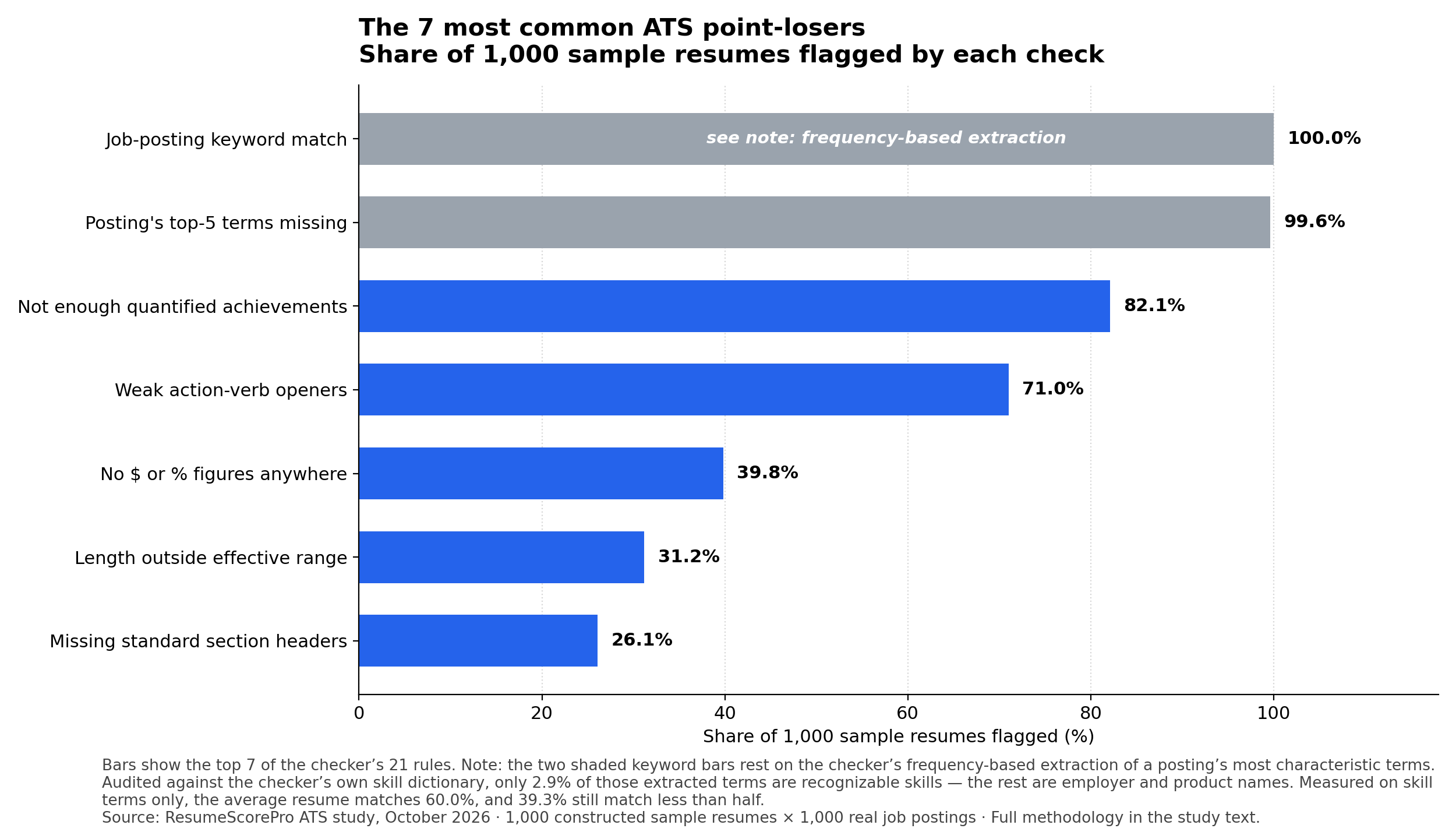
The 7 most common point-losers
Ranked by the share of the 1,000 resumes the checker flagged. Percentages are taken directly from the per-resume results file published with this study — anyone can recount them.
1. Job-posting keyword match — flagged on 100.0% of resumes
The checker extracts the 24 most characteristic terms from a real posting and measures how many appear in the resume. On that raw measure, the average resume matched 15%, and every single resume in the sample fell below the 50% line the checker treats as adequate. But treat the 15% for what it is: the number a naive frequency-extraction algorithm produces — the same kind of number most "keyword match rate" tools report. The honest footnote below decomposes it: 97% of the extracted terms are employer and product names, not skills. Measured against skill terms only, the average resume matched 60.0% — and 39.3% still matched less than half of the actual skill vocabulary in their target posting. That second pair of numbers is the finding; the 15% is the cautionary tale about the measuring stick.
2. The posting's top-5 terms missing — 99.6%
Nearly every resume was missing at least one of the five most important terms in its target posting. These carry the most weight in the checker's keyword dimension (35% of the total score).
3. Not enough quantified achievements — 82.1%
The checker counts measurable results (money, percentages, multipliers, team/user/project counts). 57.5% of resumes had fewer than three — and 82.1% had fewer than the 6–8 that earn full marks. Duty statements ("responsible for reporting") are everywhere; outcomes are rare.
4. Bullets that don't open with a strong action verb — 71.0%
Seven in ten resumes had at least one bullet opening with weak phrasing such as "responsible for", "worked on", or "helped with" instead of a verb like led, built, delivered, grew.
5. No $ or % figures anywhere — 39.8%
Four in ten resumes contained no dollar or percentage figure at all — not one revenue, savings, or efficiency number.
6. Length outside the effective range — 31.2%
Too thin is the bigger problem: resumes under 200 words can't rank for anything, and 9.7% were flagged at high severity for it. A smaller share ran long enough to dilute their own keyword density.
7. Missing standard section headers — 26.1%
One in four resumes lacked at least one of the headers parsers look for — Experience / Education / Skills — usually "Skills", which connects directly to point-loser #8 (no dedicated skills list, 22.1%).
The honest footnote on #1 — read this before quoting it
A 100% flag rate sounds like a broken ruler, so we decomposed it. The checker's keyword extraction is frequency-based: it takes a posting's most characteristic terms verbatim. When we audited those terms across the 1,000 real postings, only 2.9% of them were recognizable skill terms (entries in the checker's own 144-term hard-skill dictionary or its phrase list). The rest were employer names, product names, and company-specific vocabulary that no outside resume — real or sample — could reasonably contain.
Measured against the skill terms only, the average resume matched 60.0% — and 39.3% still matched less than half of the actual skill vocabulary in their target posting. That is the defensible headline: even after you strip out the impossible terms, roughly 4 in 10 resumes don't speak the posting's skill language. It is also a finding about checkers themselves, including ours: a naive keyword score over-penalizes, which is why our checker weights keywords at 35% rather than letting them decide the verdict alone.
All 21 checks, ranked
| # | Check | Share of resumes flagged |
|---|---|---|
| 1 | JD keyword match rate | 100.0% |
| 2 | Top-5 JD terms present | 99.6% |
| 3 | Quantified achievements | 82.1% |
| 4 | Strong action-verb openers | 71.0% |
| 5 | $ / % metrics present | 39.8% |
| 6 | Resume length in range | 31.2% |
| 7 | Standard section headers | 26.1% |
| 8 | Dedicated skills list | 22.1% |
| 9 | Employment dates present | 22.0% |
| 10 | Recognized hard skills | 13.8% |
| 11 | Hard skills detected (5+) | 13.8% |
| 12 | Bullet-point experience | 13.3% |
| 13 | No filler buzzwords | 11.3% |
| 14 | No overlong lines | 7.9% |
| 15 | Phone number present | 7.4% |
| 16 | Contact info at top | 6.7% |
| 17 | Email address present | 1.4% |
| 18 | Keyword depth (used 2+ times) | 0.0% |
| 19 | Summary section | 0.0% |
| 20 | No excessive ALL-CAPS | 0.0% |
| 21 | Concise bullets (≤28 words avg) | 0.0% |
Data files published with this study: check-summary.csv (all 21 checks) and per-resume-results.csv (all 1,000 scored resumes).
Methodology — exactly what we did
The checker. All scoring used the production ResumeScorePro analyzer — the same JavaScript that runs in your browser on this site (21 checks in 5 weighted dimensions: Keywords 35%, Impact 20%, Format 20%, Brevity 15%, Skills 10%). The code was fetched from resumescorepro.com on 2026-10-31 and run unmodified (only the page's UI code was removed; the analyzer function is byte-for-byte the production one). It is archived with this study.
The job postings. 1,000 real postings sampled from a dataset of 1,187 live postings collected on 2026-10-30 from public company career pages (Greenhouse / Lever / Ashby feeds) for the ResumeScorePro jobs channel — real employer text, not templates.
The resumes — constructed samples, and why. Our checker runs 100% client-side: resumes are never uploaded, so we hold no user resumes and could not (and would not) study them. The corpus is therefore 1,000 constructed sample resumes with fictional people and fictional employers, generated by a seeded, published script (seed 20261031 — re-running it reproduces the identical corpus). Templates follow the standard formats used in publicly available example resumes. Composition by field: Engineering 240, Sales 200, Operations 170, Product 90, Support 90, Marketing 70, Data 50, Design 40, Administrative/Other 50. Each resume was paired with a real posting from its own field.
Sample traits were drawn from documented probabilities, chosen to resemble the mix seen in publicly available example resumes: 76% include a dedicated skills section; 52% a summary; 50% were "tailored" (some vocabulary borrowed from their target posting's field); bullet metric density was tiered (30% high / 40% medium / 30% low); 9% were written in paragraph style instead of bullets; 7% omitted a phone number; 2% omitted an email address; length classes ranged from deliberately thin (5%) to four-job histories (3%). Median corpus length: 258 words. Every one of these knobs is declared in the generator script published with this study, and every percentage in this article can be recomputed from the published per-resume results file.
The rules dictionary used by the checker (144 hard skills, phrases, stopwords, action verbs, and all 21 check definitions) is open-sourced alongside this study.
What this study is not
- Not user data. No real applicant's resume was used, accessed, or exists in our systems — the checker is client-side by design.
- Not a measurement of commercial ATS products. A rules checker is a transparent proxy for parsing/scoring behavior, not a copy of Workday or Greenhouse internals.
- Not a census of real job seekers. Constructed samples have less linguistic variety than real resumes, and trait rates are our documented modeling choices. Treat the rankings as "where points are lost when typical sample resumes meet real postings", not as population statistics.
Steal this stat
"97% of the 'keywords' a naive ATS checker extracts from a job posting are company and product names, not skills. Even on skills alone, 4 in 10 resumes match less than half — and 82% don't have enough measurable results." — ResumeScorePro ATS Study, October 2026
Check your own numbers free at resumescorepro.com — the same checker, running in your browser, nothing uploaded.
Research conducted by ResumeScorePro, October 2026.