How often do data jobs mention both Python and SQL? The answer hiding in forty postings
A job seeker with a strong SQL project and a Python notebook has a practical editing decision. Should the resume present these as separate skills, or should...
The shortlist overlap floor
A job seeker with a strong SQL project and a Python notebook has a practical editing decision. Should the resume present these as separate skills, or should the applicant find an example in which the tools did different parts of the same job? On ResumeScorePro's data jobs page, both terms appear near the top of the list. The page tells us how many postings mention each term individually. A little arithmetic can tell us something more useful about how frequently the same posting must mention both. Data category snapshot
We call the smallest unavoidable shared count the shortlist overlap floor. Picture a stack of job descriptions on a desk. Mark every description mentioning Python with a blue tab and every description mentioning SQL with an orange tab. If the total number of tabs exceeds the number of descriptions, some sheets must carry both colors. The floor measures how many such sheets must exist even before anyone opens the individual descriptions to identify them. It gives an applicant a defensible reason to prepare an integrated project example while keeping the actual employer's wording in charge of the application.
What the October snapshot lets us reconstruct
In the October 31, 2026 snapshot, ResumeScorePro lists 40 data and AI postings. Python appears in 32 and SQL in 29. The site counts a whole-term match once per posting even if the employer repeats the word throughout the description. The unit in the analysis below is therefore a posting, and the two counts have the same denominator. Region, employer, skill level and placement of the word within the description are separate questions. Counts and collection method
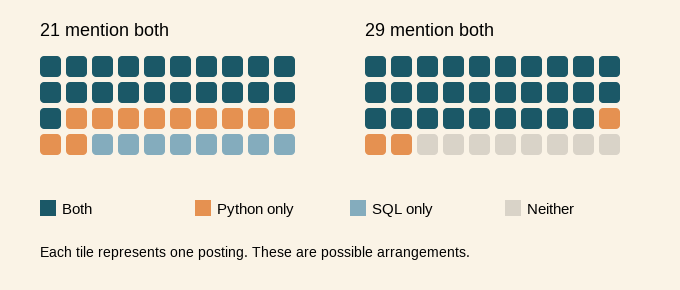
Add the two counts and you get 61 mentions counted across the two term lists. Spread them across the 40 available postings. At least 21 postings must carry both terms, because the first mention on each sheet can account for at most 40 of the 61. At the other extreme, all 29 SQL postings could sit inside the larger Python group. The true overlap therefore falls between 21 and 29 postings inclusive, or between 52.5 and 72.5 percent of this category. The range is a deduction from the published counts. It identifies no individual posting and describes no hiring outcome. Inputs for the overlap calculation
| Mathematically possible arrangement | Both terms | Python only | SQL only | Neither |
|---|---|---|---|---|
| Smallest shared group | 21 | 11 | 8 | 0 |
| Largest shared group | 29 | 3 | 0 | 8 |
You can check the first row without trusting a formula. The shared postings and the Python-only postings sum to 32. The shared postings and the SQL-only postings sum to 29. Adding all the mutually exclusive cells gives 40. Repeat the exercise for the second row and the same margins reappear. Those two arrangements would look identical on a page publishing only individual term counts. The underlying job lists would be different enough to change which project a particular applicant chose to feature. Snapshot behind both hypothetical arrangements
There is another result here for a candidate who knows SQL well and is still learning Python. Up to eight postings could mention SQL without mentioning Python. The lower bound for that group is zero. It would be a mistake to promise this candidate eight suitable openings on the strength of the category summary. It would also be a mistake to advise them to abandon the category. The next useful unit of research is the actual sentence in a live posting where the employer describes the analysis to be performed. That sentence can reveal an alternative qualification or a division of labor that disappears in the count. Bounds derived from the data category
A narrower search changes the denominator again. Among the 29 postings that mention SQL, at least 21 must also mention Python, which puts the lower bound a little above 72 percent. Among the 32 that mention Python, the same minimum of 21 works out to just under 66 percent. The numerator stays still while the applicant's entry point changes. Someone browsing specifically for SQL work has a stronger lower bound for encountering Python than a reader picking a posting at random from the entire category. This is a property of the text collection and the chosen filter. It gives no estimate of the probability that a given application will pass screening. Term counts
How much does that choice of category matter? Consider the engineering page from the same collection date. Python appears in 101 of 286 engineering postings, compared with 32 of 40 in data and AI. Engineering supplies 69 more Python mentions in absolute terms, yet the term appears in roughly 35 percent of engineering postings versus 80 percent of data postings. For someone who wants many descriptions to read, engineering provides a larger pile. For someone who wants a high concentration of Python mentions per description opened, the smaller data category is the more efficient starting point in this snapshot. Engineering counts · Data counts
Employer concentration places another limit on the result. The data category's 40 postings come from 15 employers, with nine attributed to Affirm. Removing that employer would leave 31 postings. Even if every one of the nine removed postings belonged to the minimum shared group, at least 12 of the remaining postings would still mention both tools. But the conclusion that a majority must mention both would no longer follow from that lower bound. A candidate excluding an employer for location or personal preference has changed a material part of a small sample. The original majority finding cannot automatically travel with the shortened list. Employer and posting counts
The site also counts 18 postings mentioning machine learning. Could you use these totals to say most data jobs demand a combined stack of Python, SQL and machine learning? Even the smallest Python and SQL overlap, at 21 postings, could fit alongside a disjoint group of 18 machine learning postings inside a collection of 40. The sizes alone permit a three-way intersection of zero. They also permit all 18 machine learning postings to fall inside the shared group. A plausible-sounding description of the typical stack would be much stronger than the evidence. That is a good reason to keep a separate example of modeling work when a target job actually names it. Machine learning and language counts
Questions to settle before rewriting the resume
What does an integrated example look like in practice?
Consider an illustrative project in which an analyst had to explain a sudden decline in successful subscription renewals. The applicant used SQL to identify eligible accounts and align renewal events with billing dates. They used Python to inspect unusual sequences and visualize where failures clustered. A useful project bullet would say what the analyst investigated, which step each tool performed and what the investigation established. If the analysis isolated a logging problem, that is the result to describe. Crediting the applicant with a revenue increase would require separate evidence that the issue was fixed and that the fix actually changed revenue.
An applicant who did only the database work still has a strong story. They might explain why their initial query counted retries as separate renewals, how they detected the discrepancy, and which event they chose as the unit of analysis. If a colleague created the notebook, the applicant can accurately describe handing a clean cohort to that colleague. This makes a much more revealing interview example than a list of language names. The arithmetic above justifies preparing for a conversation about both tools. It supplies no reason to inflate an individual's contribution.
How should I read a posting that includes both words?
Start at the sentence containing each term and read the section heading above it. An employer might name SQL in a responsibility for maintaining a reporting model and Python in a description of the broader team's stack. Another might request experience in either language. Both descriptions can contribute exactly the same pair of marks to the category summary. Save the exact qualification and write a plain-English question beside it. Who owns the task, what would they deliver and which tool, if any, does the employer specify for doing it? The answer determines how much resume space is warranted.
Could these calculations tell me which tool to learn next?
They can help you design a small reading exercise before investing in a course. Open jobs you could genuinely accept given your location, level and preferred work. Record whether the tool is required, preferred, an alternative or simply mentioned in passing. Keep the description and the date beside that judgment. After this pass, look at the work you would be unable to do today. A missing skill tied to a real responsibility gives you a concrete learning project. A missing word in a team description might warrant little more than a question for the recruiter.
What should I do if I can reproduce the counts but disagree with the conclusion?
Check which conclusion is at issue. The published margins force a minimum shared count within the stated set. A claim about which tool employers value more, which jobs are currently available, or who is likely to receive an offer requires different evidence. You can accept the arithmetic and reasonably make a different career decision. For instance, a person who prefers database design may deliberately target a smaller pool of relevant jobs and give less weight to the frequency of Python elsewhere. The table helps explain that tradeoff without assigning a score to the person making it.
A quick way to keep your own notes honest is to add a separate column for evidence of use at work. A posting can mention both languages while your project supports only the database part. Writing those observations beside each other makes the remaining question visible before a recruiter asks it.
What to take into the application
Prepare a shared project example if you have one, preserve separate evidence of the work you personally performed, and let the target posting determine what leads your resume. Across the October snapshot, the overlap can be bounded even when the exact list of shared postings is unavailable. That numerical result is useful precisely because it answers a limited question. It tells you which conversation is worth preparing for, while leaving the employer's actual requirements and your own experience to determine what you can truthfully say. Source snapshot